
Getting organized is about more than buying a planner or downloading a to-do list app. A 2024 systematic review by Singh et al. in the journal Healthcare shows that the time it takes to establish a habit varies considerably from person to person, and that most studies on the subject have a high risk of bias.
In other words, the promise of forming a routine in a fixed number of days doesn’t hold up. The real challenge lies elsewhere: how do you build an organizational system that can withstand chaotic weeks, unexpected health issues and dips in motivation, without letting one missed day bring everything crashing down?
Getting back on track after a disruption: the least-taught organizational skill
Most organization guides focus on starting a routine: listing your tasks, blocking out time slots, tidying your home. This advice works as long as the week goes according to plan.
The problem arises when the routine breaks down. Three days with the flu, an unexpected business trip, a week of being overloaded at work. Getting back to your previous system then becomes more of a psychological obstacle than a logistical one.
The research reviewed by Singh et al. in 2024 focuses on repetition in a consistent context. When the context changes, the habit mechanism becomes less reliable. Rather than aiming for a perfect streak of organized days, it’s more realistic to plan from the outset how to get back on track after forgetting or taking a break.
In practice, this means making what researchers call a distinction between “getting started” and “sticking with it over time.” The first involves planning; the second, the ability to start again without feeling guilty. Becoming an organized person in everyday life means accepting that disruptions are part of the process, not something that sabotages it.

Stable cues instead of notifications: building organization into everyday life
Reminder apps and phone alarms create the illusion of structure. In practice, they add noise to a day already saturated with information. Eventually, you start ignoring notifications just as you ignore ads.
Research on habit formation reviewed in the 2024 paper points to a different approach: linking an action to a cue that’s already part of your day. Tidy the countertop right after dinner. Pack your bag in the morning while the coffee brews. Sort the mail when you get home, before putting down your keys.
These cues work because they don’t depend on an external tool. They build on moments that are already part of your day, reducing the effort involved in making decisions. However, the review notes that evidence on this point is still limited, and that effectiveness varies depending on the individual and the behavior in question.
“If… then…” plans and their limitations
A 2024 online meta-analysis by Sheeran, Listrom and Gollwitzer, synthesizing 642 tests of implementation intentions, shows that specific plans such as “if I finish dinner, then I’ll get my things ready for tomorrow” have varying effects depending on the outcomes targeted and the conditions. This format can help people take action in some cases, but it isn’t a universal solution.
These plans can still be useful for simple, one-off tasks: making a grocery list on Sunday evening or clearing your inbox at a set time. For more complex goals (reorganizing your entire workweek or setting up a home management system), an “if… then…” plan isn’t enough. You need a broader framework.
Building a simple organizational system that lasts
An effective organizational system isn’t one that covers every aspect of your life. It’s one you’re still using three months later. The difference often comes down to how simple the system is.
- Choose one tracking tool (paper planner, app or notebook) and stick with it. Using multiple tools means having more places where information can get lost.
- Keep your daily to-do list to what you can realistically get done that day. An overly long list creates a sense of failure at the end of the day, not productivity.
- Set aside a few minutes each week to adjust the week ahead—not to plan every hour, but to identify the two or three priorities that really matter.
- Build a restart rule into your system: if you miss a day, pick up again the next day with the easiest task, without trying to catch up.
A good organizational system absorbs the unexpected instead of collapsing under its weight. Resilience matters more than precision.
Tasks and priorities: the difference between urgent and foundational
Sorting tasks by urgency keeps you in a constant state of reaction: answering an urgent email, calling the plumber, signing a document before the deadline. These actions use up energy without moving long-term projects forward.
Foundational tasks are the ones that, when done regularly, reduce the number of future emergencies. Preparing the week’s meals on Sunday prevents a frantic grocery run on Wednesday. Tidying your workspace every evening saves you from searching for documents the next morning.
Spending even a few minutes a day on a foundational task has a cumulative effect on how organized your week is overall.
Organization at work and at home: two contexts, one shared principle
Professional and household organization share a common mechanism: reducing micro-decisions. Every time you ask yourself, “What should I start with?”, you use up a limited cognitive resource.
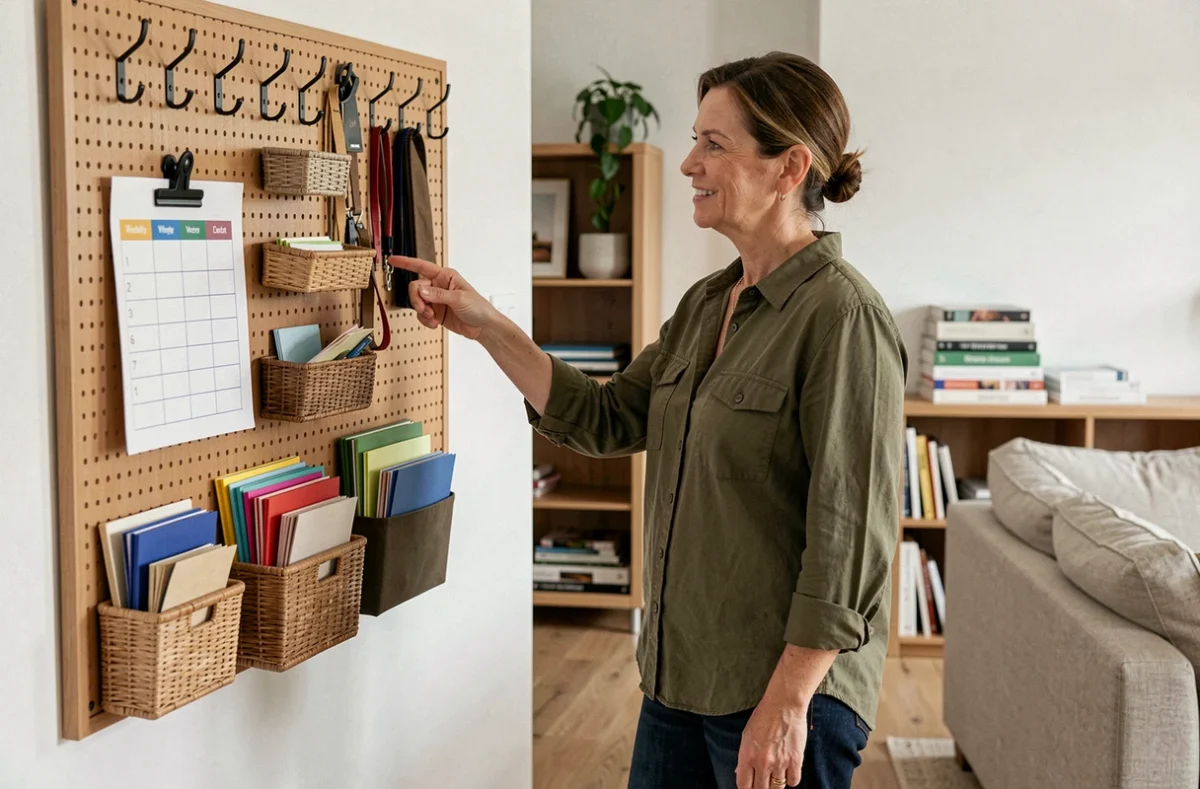
At work, this means preparing for the day at the end of the previous one: identify the first task for tomorrow before leaving your desk. At home, it means assigning fixed places to everyday items and creating short routines (five to ten minutes) tied to specific moments.
The difference between the two contexts comes down to predictability. At work, interruptions often come from other people (meetings, urgent requests). At home, they come from life itself (children, fatigue, the weather). Adapting your system to each context instead of looking for a one-size-fits-all model helps avoid the frustration of never reaching a theoretical ideal.
- At work: block out an uninterrupted period for your most demanding task, even if it lasts only thirty minutes.
- At home: pair tidying or getting things ready with something enjoyable (music, a podcast) to make it easier to get started.
- In both cases: accept that a day that’s only partly organized is still an organized day.
Organization isn’t a fixed personality trait. It’s a skill developed through repetition, weakened by interruptions and regained by starting again. The only real failure would be deciding that a system you abandoned for a week isn’t worth restarting.