
In French law, the term “shared custody” has no legal existence. The Civil Code only recognizes alternating residence, as provided in article 373-2-9, or residence fixed with one parent accompanied by a right of visitation and accommodation. This confusion in vocabulary, however, leads to concrete misunderstandings about each parent’s rights, the calculation of child support, and the sharing of family benefits.
Alternating residence: what the Civil Code specifically states
Article 373-2-9 of the Civil Code allows the family court judge to set the child’s residence alternately at each parent’s home. This text never mentions the term “shared custody”.
A point often misunderstood: alternation does not impose a strictly equal sharing of time. The judge can decide on an asymmetric schedule, for example, ten days with one parent and four with the other, while still qualifying the arrangement as alternating residence. The judge can also order this alternation provisionally, for a duration he determines, before making a final ruling.
According to Insee, in 2023, about 14% of children whose parents are separated lived in alternating residence. This figure, which has been steadily increasing since the law of March 4, 2002, remains a minority. Residence primarily with one parent remains the most common configuration, and it is possible to find useful information on Parents Infos to explore the concrete implications of each arrangement.
Shared custody: why this term is confusing
“Shared custody” is a common language expression, not a category of family law. It encompasses very different realities depending on the families that use it.
Some parents use it to refer to a classic alternating residence, with a schedule of one week on, one week off. Others use it to describe an arrangement where the child primarily lives with one parent but spends extended weekends and half of the holidays with the other. These two situations do not have the same legal status, nor the same consequences for child support or benefits.
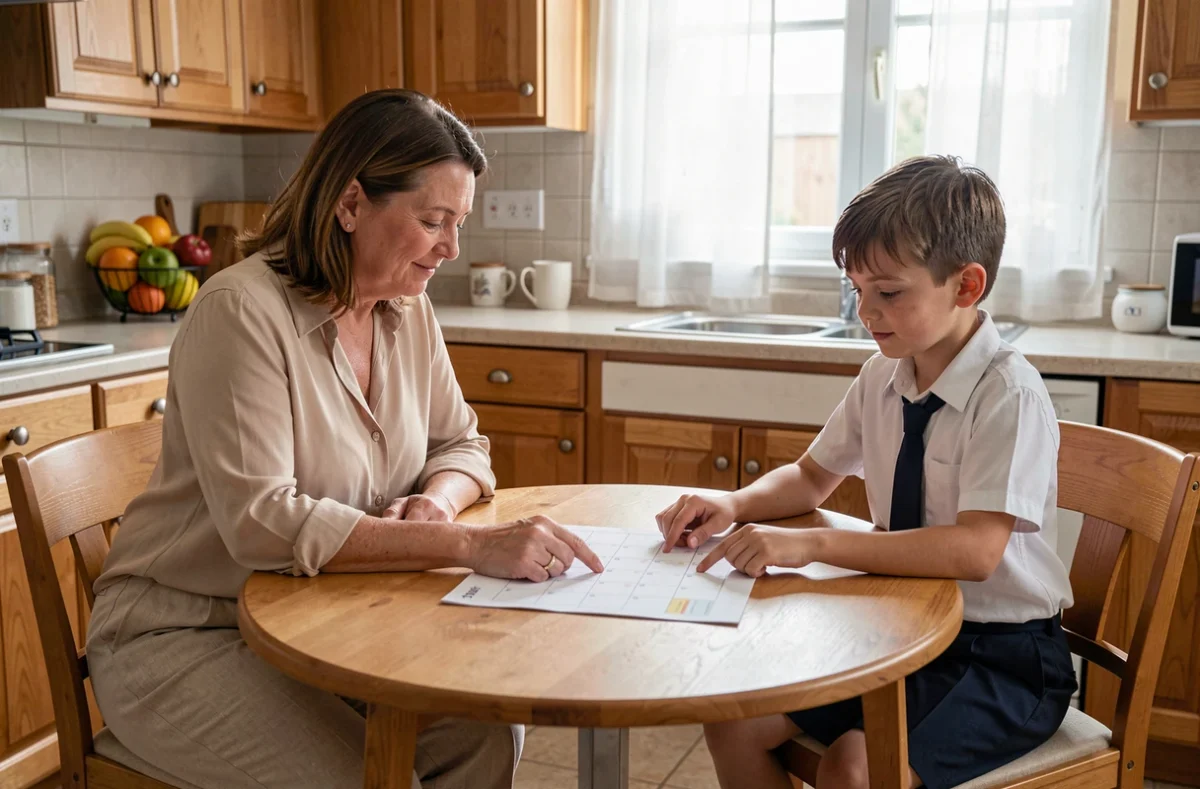
The problem arises when parents reach an amicable agreement using the term “shared custody” without specifying the child’s actual schedule. In the event of a later conflict, the judge will rely on the actual time spent with each parent, not on the label chosen by the parties.
Child support and CAF benefits in alternating residence
The most persistent misconception is that alternating residence automatically eliminates child support. This is false. A financial contribution may still be owed even in alternating arrangements, as long as there is a significant income gap between the parents or one of them incurs more ongoing expenses for the child (tuition fees, activities, health).
The judge evaluates the situation on a case-by-case basis. The mere equality of time spent does not suffice to conclude that each parent contributes equally to the child’s needs.
Regarding family benefits, alternating residence opens the possibility of sharing benefits between the two parents with CAF. Parents can choose a single beneficiary or request a split. In the absence of an agreement, CAF applies a default sharing. The rules vary depending on the benefit concerned:
- Family allowances can be shared equally between the two parents, upon request or in case of disagreement.
- The free choice of childcare supplement (CMG) follows specific rules: each parent can, under certain conditions, receive assistance for their own childcare arrangement.
- Some aids, such as the back-to-school allowance, are paid only to one beneficiary, which forces parents to agree or leave CAF to decide.
Criteria for the family court judge to set residence
When parents cannot reach an agreement, the judge decides based on the best interest of the child. This general principle translates into the examination of concrete criteria:
- The geographical proximity of the two homes, particularly in relation to the child’s school.
- The actual availability of each parent to ensure daily care (work hours, business travel).
- The quality of the relationships between the child and each parent, sometimes assessed by a social investigation or a medico-psychological expert evaluation.
- The parents’ ability to cooperate. An acute parental conflict may lead the judge to dismiss alternating residence, even if both parents request it.
The judge may order a provisional alternating residence to test the arrangement before confirming or abandoning it. This trial phase, which varies in duration, allows observation of how the child adapts to the proposed schedule.
Parental authority remains joint in all cases, regardless of the chosen residence mode. Alternating residence and primary residence with one parent do not affect parental rights and duties: both parents continue to make decisions together regarding the child’s health, education, and schooling.

The distinction between “alternating custody” and “shared custody” is therefore not just a nuance of vocabulary. It separates a precise legal framework, with measurable consequences on support, benefits, and calendar organization, from a vague expression that protects neither parents nor the child in case of disagreement. Using the exact terms of the Civil Code in a parental agreement remains the safest way to avoid costly disputes.